Κυριακή, Σεπτεμβρίου 24, 2006

Σκέψεις για τις σχέσεις...


Ένα τροχαίο όσο σοβαρό ή λιγότερο σοβαρό και αν είναι σε βάζει σε σκέψεις και αν θέλετε σε ταρακουνάει σε πολλά επίπεδα. Μερικά δέκατα του δευτερολέπτου μπορούν να αλλάξουν τα πάντα γύρω σου...Λόγω της κατάστασής μου, σήμερα έκατσα στην οθόνη μπροστά και επειδή είμαι σε διάθεση ευαίσθητη ήθελα να γράψω τις ακόλουθες σκέψεις γιατί τελικά πρέπει αυτό που αισθανόμαστε να το εκφράζουμε έγκαιρα και ευτυχώς που κάτι τέτοιο συμβαίνει στην σχέση μας. Απλά θα ήθελα να το μοιραστώ και μαζί σας:

Σκεφτόμενη τον άνθρωπό μου, ευγνωμονώ την στιγμή που οι δρόμοι μας συναντήθηκαν. Για πόσο; Άγνωστο. Το σίγουρο είναι πως όλες οι σχέσεις θέλουν κόπο και ανοιχτή ακρόαση.

Αυτό που μου αρέσει πάνω απο όλα είναι η κατανόηση, η επικοινωνία και ο 'χώρος' που δίνει η μία στην άλλη. Πιστεύω πως όλα τα παραπάνω, πέρα απο την πολύ αγάπη, είναι απαραίτητα συστατικά για να 'δέσει το γλυκό'. Υπάρχουν και οι στιγμές που οι προσδοκίες μας, τα θέλω μας, υπερβαίνουν αυτό που μπορεί να δώσει ο άλλος και τότε γινόμαστε εγωιστές, ζηλιάρηδες και πάει λέγοντας.

Όταν σκέφτομαι την σχέση μας, θυμάμαι τα λόγια του Khalil Gibran για τον Γάμο - και εγώ το επεκτείνω νοητικά και στις σχέσεις. Τα γράφω και στα ελληνικά και στό πρωτότυπο κείμενο στα αγγλικά που μου αρέσει πολύ:

Γεννηθήκατε μαζί και θα είστε παντοτινά μαζί[...]
Αφήστε όμως να υπάρχουν και αποστάσεις στην ένωσή σας[...]
Αγαπάτε ο ένας τον άλλο αλλά μην κάνετε δεσμά απο την αγάπη:
Αφήστε την αγάπη να είναι σαν μια κινούμενη θάλασσα στις ακτές των ψυχών σας [...]

Τραγουδάτε και χορευέτε μαζί και ας μένει ο καθένας μόνος του,
Καθώς οι χορδές του λαούτου είναι μόνες,
Παρ' όλο που δονούνται με την ίδια μουσική

You were born together, and together you shall be forevermore[...]

But let there be spaces in your togetherness,

Love one another but make not a bond of love:
Let it rather be a moving sea between the shores of your souls

Sing and dance together and be joyous, but let each one of you be alone,
Even as the strings of a lute are alone though they quiver with the same music


Καληνύχτα σας

Τρίτη, Σεπτεμβρίου 19, 2006

ΑΝΕΠΙΔΟΤΕΣ ΕΠΙΣΤΟΛΕΣ 5. ΔΗΜΟΤΙΚΕΣ - ΝΟΜΑΡΧΙΑΚΕΣ ΕΚΛΟΓΕΣ 2006

Πολλές αντικρουόμενες και σκόρπιες σκέψεις μου έρχονται συνειρμικά διαβάζοντας την επιστολή. Θεωρώ πως θέτει συνοπτικά όλα τα καίρια ζητήματα που μας απασχολούν σε σχέση με την παρουσία μας και την θέση μας στους δήμους και κοινότητες της διαμονής μας.

Επειδή τώρα αρχίζω σιγά σιγά και ασχολούμαι πιο εμπεριστατωμένα με τα δικαιώματα των ομοφυλόφιλών και επειδή δεν γνωρίζω και πολλά για την ιστορία και όσα έχουν γίνει στο παρασκήνιο της ιστορίας της ελληνικής ομοφυλοφιλικής κοινότητας κάνω μια ερώτηση:
Μήπως τέτοιες επιστολές θα ήταν καλό να στέλνονται πιο συχνά και όχι μόνο λίγο πριν τις εκλογές;
Απο την άλλη και για να κάνω τον δικηγόρο του διαβόλου όταν κάποια στιγμή για τον οποιοδήποτε λόγο θα κλιθούμε να βάλουμε την υπογραφή μας σε τέτοιου είδους διαμαρτυρίες ή επιστολές και για να αποδείξουμε έμπρακτα πλέον, έστω και με αυτόν τον τρόπο αυτό που πρεσβεύουμε στην καθημερινή μας ζωή και στα ιστολόγιά μας, θα το κάνουμε;
(Θα ήθελα πολύ να πιστευω πως ναι. Όπως θα ήθελα να πιστεύω ότι θα υπογράψουν και ετερόφυλοι που σέβονται τον σεξουαλικό προσανατολισμό του διπλανού τους)


Επίσης σκέφτομαι και το ακόλουθο: υπάρχουν πάρα πολλοί ομοφυλόφιλοι/ες που έχουν δικό τους ιστολόγιο και έτσι μπορούν να εκφράζονται ελεύθερα και να διακινούνται ιδέες, νέα και άρθρα αλλά κρυβόμαστε πίσω απο την ανωνυμία μας. (Υπάρχουν βέβαια και περίπτωσεις όπου καλλιεργούνται πραγματικές φιλίες μέσα απο μια τέτοιου είδους επικοινωνία οπότε η ανωνυμία πλέον δεν υπάρχει)

Καταλήγω πάλι στην χιλιοειπωμένη δήλωση ότι δεν είναι η κοινωνία μας έτοιμη να δεχτεί αυτό που θεωρείτε διαφορετικό. Και για να μπορέσεις να το πείς να 5-10 ανθρώπους πρέπει να δουλέψεις πολύ τον εαυτό σου, να σε δεχτείς...

Επίσης είναι πολύ εύκολο όσοι δεν είναι οργανωμένοι να περιμένουν στην γωνία και να κρίνουν μόνο αρνητικά τις προθέσεις που βρίσκονται πίσω απο κάποια προσπάθεια. Όχι πως πρέπει να τα δεχόμαστε όλα και να συμφωνούμε σε όλα, σωστά;

Καταλήγω να κάνω την ακόλουθη σκέψη: Για τις αρνητικές σκέψεις και τα συναισθήματα που προκαλούνται στους περισσότερους ετερόφυλους σε ότι αφορά τα δικαιώματα μου έχω μερίδιο ευθύνης και εγώ...

Ίσως όμως αυτό το ιστολόγιο να είναι μόνο η αρχή μας και όχι το τέλος της προσπάθειάς μας...

Δεν ξέρω αλλά κλείνοντας το πόστ θυμάμαι την ακόλουθη φράση του Άμλετ
To be honest as this world goes, is to be one man picked out of ten thousand


Παρασκευή, Σεπτεμβρίου 15, 2006

Lesbian News - August 2006

International News

CHINA BANS SOUTH KOREAN MOVIE
Chinese censors have banned South Korea's top-grossing film because of language and implied gay romance. The "King and the Clown" failed to pass muster with the State Administration of Radio, Film and Television. The censors reportedly objected to longing glances between the king and an effeminate clown during a puppet show they perform together.
SWEDISH ANTIGAYS CONVICTED OF HATE CRIME
Four Swedish antigay activists were convicted of illegal agitation against a minority group July 6 for distributing pamphlets that, among other things, blamed gays' "promiscuous lifestyles" for the "plague" of AIDS.
The literature was passed out near a school in Söderhamn, 150 miles north of Stockholm.
The Supreme Court punished three of the men pended sentence and a fine of 100 days' salary; the fourth was given a year of probation.
NORWEGIAN POLITICIAN, NEWSPAPER CHARGED WITH DISCRIMINATION
A municipal councilor and a newspaper in Farsund, Norway, have been accused of discrimination over a letter to the editor the politician wrote calling for a straights-only beach, the Aftenposten daily reported July 11.
Odd Djøseland, a member of the right-wing Progress Party, maintains his letter was a joke. In it, he claimed heterosexual beachgoers are uncomfortable when gays "drool" over them. "I therefore want a beach in our community that's free of gays and lesbians, a place where we normal, heterosexual people can sunbathe and swim in peace and quiet," he said.
But some readers didn't see the humor. Local bisexual Bent Sandvand was "offended and insulted," and filed a complaint against Djøseland with police. And reader Steinar Spjelkaviknes filed a complaint against the newspaper, Farsunds Avis, alleging violation of press rules concerning respect for people's identities.
MAURESMO WINS WIMBLEDON
French lesbian Amé1ie Mauresmo won the Wimbledon title July 8, thereby becoming the No. 1 women's tennis player in the world. She beat Belgium's Justine Henin-Hardenne 2-6, 6-3, 6-4.
"I wasn't playing my best tennis, far from it. That kind of day happens," Henin-Hardenne explained.
Mauresmo said of her win: "It is very sweet. Maybe if it came seven years ago it would not have had the same taste. Things come when they have to come.
"It seems I have finally found how to handle the nerves a bit better," she added. "I really know more now how to play tennis than a few years ago. I think everything is really coming together."
CHILE MAY REPEAL ANTIGAY LAWS
Chile's Congress is considering repeal of laws that have been used to harass gays. The regulations, which ban "offenses to morals and good customs," have been used against GLBT people who express their sexual orientation in public.
Lawmakers also are debating gay-inclusive hate-crimes legislation. Gay activists think there is a better chance of advancing their agenda under Chile's new president, socialist Michelle Bachelet.
CANADIAN GOV'T ACCUSED OF BLOCKING OUTGAMES VISAS
Canada's government is denying and delaying visas for some people planning to attend the 1st World Outgames July 29-August 5 in Montreal, Liberal members of Parliament charged July 11.
Quebec MP Raymonde Folco said more than 250 individuals -- mostly participants in an associated human-rights conference -- lack entry visas, and that the new Conservative government's antigay sentiments may be to blame. "I would like to be generous and say there may be another common denominator, but I don't see it," she said.
A spokeswoman for Citizenship and Immigration Minister Monte Solberg dismissed the accusation, telling the Winnipeg Sun that "most of the applicants are still in the normal review process." At the same time, the spokeswoman, Lesley Harmer, told the Montreal Gazette that more than half of the individuals in question have yet to submit a visa application.
Outgames Press Secretary Pascal Dessureault said he is "really worried" about the delays.
PORTO SEES FIRST PRIDE PARADE
About 300 people marched in the first gay pride parade in Porto, Portugal, July 8. The city, Portugal's second largest, has had pride events since 2001, but never a parade.
The march started at the location where a transgender woman was killed this year, then proceeded through the narrow streets of the old city to a rally point in a central square near City Hall.
In February, "Gisberta" was beaten, stoned, stomped, burned and sexually assaulted with a stick for two days, then thrown alive into a deep pit at the abandoned building where she lived. Fourteen boys admitted involvement in the crime. Their trial, closed to the public, is under way.
~~~~~~~~
By Rex Wockner

The Empty Closet Digitization Project

Αυτό είναι το άρθρο σχετικά με την ψηφιοποίηση του περιοδικού Empty Closet.
Θα το βρείτε στην ακόλουθη ιστοσελίδα:
http://www.gayalliance.org/content/view/602


Written by Susan Jordan
Tuesday, 05 September 2006


Michael Robertson, library technician and one of the founders of the Gay Alliance of the Genesee Valley, is in the process of preserving the past 35 years of the Empty Closet and making the entire paper available for search and display on the Internet. He is currently seeking funding.

Empty Closet: What is your history with the Gay Alliance?
Michael Robertson: I was one of the founding members; I was the second or third president, I can’t quite remember which. I was a grad student at Geneseo coming to the meetings of the Gay Liberation Front at the University of Rochester in the fall of 1972.U.R. said in 1973 that they wouldn’t fund the group anymore because non-students were attending. So in the summer of ’73, the GAGV was founded. In fact I met with a lawyer, Emmeline Logan-Baldwin, to go through the motions of incorporating the GAGV as a 501 3c non-profit.We passed the hat at the Sunday night meetings – that was the GAGV budget. The first center was on Brown St. We were only there a few months and then we moved to the Genesee Co-op on Monroe Ave. We had some trouble – a state legislator swore he would block our incorporation, but he wasn’t able to…. And of course we had frequent death threats.

EC: What is the project about? What are you trying to accomplish?

MR: All we have of the Empty Closet are the print editions, nothing on microfilm or digital. The U.R. Rare Books and Archives Division has almost a complete run of the paper, starting with the very first issue, January 1971.Connie Gates and I have spent the past two years inventorying every last issue and page number, through January 2004. There are over 9,000 pages!U.R. wasn’t sure they had a complete run. We were looking to see not only which issues were missing, but which were damaged and should be replaced before they were scanned on microfilm or digitized. There were only four missing issues, which was remarkable, and five damaged ones, and we were able to replace them with the help of community members, primarily Whitey LeBlanc, the first president of the Gay Alliance.We stopped at 2004 because Jim Anderson (EC graphic designer) discovered in the fall of 2004 that we can digitize entire publications without scanning. Our original goal was simply to digitize all issues and make them available on the web for search and display. After delving into it, I learned that the best way was to have it microfilmed first – microfilm will last for 500 years. Digital copies, or the material they’re stored on, changes so often that they may not be readable after a few years. Microfilm is a sure bet and there won’t be a problem reading it in 500 years.Much to my surprise, it turned out that we had over 9,000 pages to scan, so I realized the best approach was first to microfilm and from that make digital copies, which we can make available on the Internet. Historically it’s very important to have stored copies of the print edition. Since the EC and Gay Liberation Front were both born at U.R., the university feels they have real importance, and they have tried to collect every issue and move them, unfolded, into acid free boxes in their huge temperature-controlled preservation room. The problem with the ‘70s and ‘80s issues is that they have turned yellow and are crumbling, even in preservation boxes, and they can’t be scanned.We also recorded all the different editors of the paper, and the four different sizes: first the paper was 8 1/2 x 11, then 8 1/2 x 10”, then 8 1/2 x 14, and finally the current size, 11 1/2 x 17.U.R. suggested that we get funding to send their collection for microfilming and digitizing to a national organization that does this kind of work, mostly for newspapers – the OCLT. That once was something like “Online Ohio College Library catalogue” – but now it’s a national non-profit just known as OCLT. We’re applying for this funding right now.

EC: What do you feel are the chief benefits to doing this project?

MR: There are so many reasons to preserve the EC. I think most of us underestimate the importance – local, statewide, even national –of those 9,000 pages. It after all documents our social and political history, our struggle for equal rights, gay community involvement in art and culture, literary productions, news from this area, New York and the national movement.Since it is crumbling, and we do want to keep a record for research purposes as well, it needs to be there to serve as a means of educating the public about what has happened in the gay community. Education counters discrimination and hate crimes, and aids acceptance of the gay community. It’s just so important that it’s there as an educational tool as well as historical record. If we forget our past we’re doomed to repeat it, and we can’t build on it. I’ll bet there have been well over 1,000 people involved in producing the paper over the years, mostly volunteers who have contributed thousands of hours – and then the thousands of people who have read it and had it change their lives.The fact that it will be available online is one more factor to help people today, and it will particularly help gay youth. It will be more accessible online.I’ve been brainstorming about starting a searchable database on the web of what we currently have available in digital form. The CDs from the last few years can be converted into pdf files that give an image of the actual pages, and that you can look through. We have current issues in the database and now we need to microfilm and then digitize the archival editions.It was my idea to do this project; the initiative came from me and not the Gay Alliance. The agency has struggled to keep going, much less to spend thousands on something that’s not a basic priority. So I have never asked the GAGV for money. We’re hopefully optimistic about getting funding – but we haven’t got it yet.The Human Sexuality Archives at Cornell University library is very interested in seeing the EC digitized and would like to have a complete run as well. They understand the importance of this historically. Also the Rochester Public Library purports to have a complete run. Theirs is not in a preservation environment and they are concerned about deterioration of the older issues.
EC: How has the climate changed for the lgbt community in the last 35 years – what strikes you the most?
MR: Some things have changed dramatically and some have sadly remained the same. We have made much more progress politically and in gaining acceptance than I thought we would 30 years ago. Debates about equal marriage rights have been a real mind-blowing thing for me in terms of social revolution.The part that makes me sad is that we are still victims of hate crimes. People still want to kill and hurt us. That’s the part I would change – that there is still violence against us.

EC: Anything to add?
MR: I want to emphasize that the collection at UR Rare Books Department is open to the public. You have to sign in and ask specifically for the issues you want to see. You have to lock up your briefcase and can’t bring in pens – just pencils. They do take some security precautions.We’ve received letters of support for our grant application from the head of the Rochester Public Library Local History and Geneaology Department, as well as from RIT Library Director Chan McKenzie, and also from Cornell. U.R. has asked us to say in our application that they want to deposit both microfilms and copies of digital files in their collection in the Rare Books Archives, and to store one copy of the microfilm in underground storage in a national storage facility – for posterity.

Last Updated ( Tuesday, 05 September 2006 )

Πέμπτη, Σεπτεμβρίου 14, 2006

The Empty Closet

Η ιστοσελίδα ενός απο τα παλαιότερα gay περιοδικά στην Αμερική, του Empty Closet, είναι η ακόλουθη:

http://www.gayalliance.org/component/option,com_mamboezine/Itemid,88/

Μάλιστα, σε ένα άρθρο στις αρχές Σεπτέμβρη διάβασα οτι έχουν αποδελτιωθεί 9.000 άρθρα του περιοδικού μέχρι το 2004 με σκοπό την ψηφιοποίηση τους. Όταν ολοκληρωθεί το έργο αυτό οποιοσδήποτε με μια απλή έρευνα με λέξεις κλειδιά θα μπορεί να έχει πρόσβαση στο αρχείο του περιοδικού.

Αυτό συμβαίνει στην Αμερική τώρα. Εμείς στην Ελλάδα τέτοια περιοδικά παύουν να εκδίδονται. Όπως το 10%. Δεν γνωρίζω τις πραγματικές λεπτομέρειες και του λόγους. Σίγουρα υπάρχουν και άλλες εκδοτικές δραστηριότητες με σχετική θεματολογία και καλό θα ήταν να προσπαθήσουμε όλοι μας να τις υποστηρίξουμε.

Δεύτερο δέρμα;


Προτείνουμε ανεπιφύλακτα την ταινία Segunda piel του Gerardo Vera. Με Javier Bardem, Jordi Molla, Ariadna Gil και Cecilia Roth.

Η ιστορία έχει ως εξής: Κλασσικό τρίγωνο: ένα παντρεμένο ζευγάρι και ο εραστής. Συνηθισμένη θεματολογία σε ταινίες που συναντάμε και στην πραγματικότητα. Ο εραστής στην προκειμένη περίπτωση είναι του συζύγου. Κάτι που επίσης συμβαίνει στην πραγματικότητα αλλά αποτελεί επτασφράγιστο μυστικό...
Έχουμε τον Alberto παντρεμένο, μηχανικό αεροσκαφών που έχει σχέση με τον Diego χειρούργο. Τι συμβαίνει όμως όταν η γυναίκα του ανακαλύπτει την σχέση του; Πως το αντιμετωπίζει; Αλλά κυρίως πως αντιμετωπίζει την κατάσταση ο Alberto;
Συνειδητοποιεί πως όλη του την ζωή την έχτισε στο ψέμα. Ένας άνθρωπος που έζησε εγκλωβισμένος ανάμεσα στα θέλω και τα πρέπει της κοινωνίας και που πάλεψε με επιτυχία(;) να πνίξει την ζωή που ήθελε ο ίδιος να ζήσει.

Είναι πολύ χαρακτηριστική η σκηνή κοντά στο τέλος όταν λεει ότι ‘ Έλεγα ψέματα από τότε που ήμουνα παιδί, μισούσα αυτούς με τους οποίους ήμουν στο σχολείο, μισούσα την δουλειά μου.’ Υπήρξε πολύ καλός σε όλους τους ‘ρόλους’ που χρειάστηκε να ‘παίξει’: να γίνει μηχανικός αεροπλάνων, όπως ο πατέρας του και ο παππούς του, παντρεύτηκε, έκανε οικογένεια...αλλά δεν άντεξε να φέρει τον ρόλο του σε πέρας. Τα όνειρα και τα ψέματα τον εκδικήθηκαν: όταν γνώρισε τον έρωτα της ζωής του, τον Diego, ούτε αυτό ήταν αρκετό.

Βλέπουμε την ιστορία ενός ανθρώπου που μεγάλωσε και έγινε κάτι που δεν ήθελε. Και πιστέψτε με υπάρχουν πολλοί εκεί έξω που προτιμούν την ‘θαλμπωρή’ και την ‘ήσυχη’ ζωή. Πάντοτε όμως θα υπάρχουν εκείνες οι στιγμές που οι σκέψεις βαθιά μέσα τους θα τους κυνηγούν σαν τις Ερινύες.
Την ταινία θα την βρείτε στα Seven.

Τετάρτη, Σεπτεμβρίου 13, 2006

Te doy mis oyos ή Μέσα απο τα μάτια σου

Πριν απο τρείς μέρες είδαμε την ταινία‘…Μέσα από τα μάτια σου’ της Iciar Bollain.

H ιστορία εκτυλίσσεται στην Ισπανία. Μια γυναίκα παίρνει το μικρό αγοράκι της και φεύγει από τον σύζυγο που την χτυπά... Είναι ενα θέμα χιλιοειδωμένο στην μεγάλη οθόνη. Όμως, η ματιά της σκηνοθέτιδας δεν ωραιοποιεί την κατάσταση αλλά αποδίδει την πραγματική διάσταση του προβλήματος στην σχέση του ζευγαριού όπως τα συναισθηματικά πισωγυρίσματα, τον μεγάλο έρωτα που κρύβεται πίσω απο την σχέση, την βοήθεια που ζητάει ο σύζηγος αλλά και πως 'νεκρώνουν' αυτά τα συναισθήματα όταν δεν πάει άλλο πια. Η ταινία παρουσιάζει όλες τις συναισθηματικές διακυμάνσεις της γυναίκας αλλά κυρίως το πως μια μόνο στιγμή μπορεί να οδηγήσει στην συνειδητοποίηση, την αυτογνωσία και την λύτρωση.

Έχω δει πάρα πολλές ισπανικές τανίες πιστέψτε με, αυτή θα μπορούσα να την κατατάξω στις 5 καλύτερες.

Την ταινία θα την βρείτε στα videoclub 7 που προτείνουν αυτό το διάστημα μια σειρά πολύ αξιόλογων ισπανικών ταινίων.

Τρίτη, Σεπτεμβρίου 12, 2006

Βαρέθηκα τα χωρατά ώρα γι' αυτά δεν έχω τώρα...

Πριν με ονομάσετε οτιδήποτε εγώ θα συνεχίσω να γράφω σκέψεις και να σας στέλνω άρθρα επίκαιρα και επιστημονικά για την ομοφυλοφιλία και όχι μόνο. Άρθρα και σκέψεις για το δικαίωμα του κάθε ανθρώπου να ζήσει την σύντομη ζωή του όπως θέλει. Γιατί το αύριο δεν το έχει εξασφαλίσει κανείς μας…

Ώρες ώρες σκέφτομαι τι μ*** άνθρωπος είμαι και ασχολούμαι με μικροπρέπειες των άλλων, και καταναλώνω την ζωή μου με το να αγχώνομαι και να αφήνομαι σε έναν αέναο λαβύρινθο σκέψεων και πράξεων που δεν έχουν λογική και αιτία. Εκεί που σκεφτόμουν την πορεία της σεξουαλικής μου ζωής για την οποία δεν μπορώ να πω ότι έχω παράπονο. Εκεί που πετούσα στο μικρό μου συννεφάκι σκεφτόμενη την καλή μου αγαπημένη. Τις στιγμές που την αγαπάω καθώς και αυτές που με εκνευρίζει αλλά και που πάλι την αγαπάω…εκεί που αγχωνόμουν με το μεταπτυχιακό και τις εργασίες που δεν λένε να προχωρήσουν. Εκεί που σκεφτόμουν το τι σχολιάζει η μαμά, ο μπαμπάς, ο αδελφός και ο ξάδελφος του συμπέθερου του θείου και τρωγόμουν με τα ρούχα μου… Εκεί σκάει η βόμβα: ένας φίλος έχει καρκίνο…και όλα ισοπεδώνονται. Όλες οι πεζές σκέψεις, οι μικροπρέπειες που μας βασανίζουν γίνονται καπνός και εκμηδενίζονται στο άκουσμα της λέξης και μόνο…και το μυαλό μένει κενό. Το τηλεκοντρόλ της καθημερινότητας πατάει το κόκκινο κουμπί και η οθόνη είναι μαύρη…

Και σκέφτομαι ξανά μετά το πρώτο σοκ τι μ*** άνθρωπος που είμαι και αγχώνομαι, πως αφήνω καταστάσεις να με συνεπάρουν ρε γαμώτο και να ξεχνάω να εκτιμώ αυτά που έχω δίπλα μου και μου δίνουν ζωή. Για τα απλά πράγματα μιλάω. Σκέφτομαι πως κατάντησα έτσι και πόσο γελοία αισθάνομαι γράφοντας αυτές τις γραμμές, που φαντάζουν τόσο κοινότυπες αλλά είμαι σίγουρη πως τις σκεφτόμαστε όλοι μας όταν σοκαριζόμαστε, έστω και για λίγο από κάτι. Από μια αρρώστια, από ένα ατύχημα, από έναν θάνατο… δεν σκεφτόμαστε ότι όλοι είμαστε εν δυνάμει…υποψήφιοι. Ότι τίποτα δεν είναι δεδομένο από όλα όσα έχουμε γύρω μας. Και ότι η ζωούλα αυτή που μας δόθηκε είναι πολύτιμη για να την περνάμε καταπιέζοντας τον εαυτούλη μας κάνοντας πράγματα που δεν συνάδουν με τις ιδέες μας και με την φύση μας…

Εγώ παλεύω στη φωτιά μέσα στην μπόρα
Και την αλήθεια θα την βρω στα χέρια μου και στην καρδιά μου

Δευτέρα, Σεπτεμβρίου 11, 2006

Επιστρέψαμε. :-)

Μετά από ένα μήνα και μια εβδομάδα απουσίας από την blogόφαιρα επιστρέψαμε. Όχι δεν ανήκουμε στην προνομιούχα τάξη των Ελλήνων που έχουν την δυνατότητα να προσφέρουν στους εαυτούς τους 1 μήνα διακοπές…
Λείψαμε τόσο πολύ λόγω μετακόμισης και όλων των λεπτομερειών που πρέπει να λυθούν σε μια μετακόμιση.

Λοιπόν, επειδή όπως γνωρίζετε είμαστε δύο και πολλές φορές έχουμε διαφορετικές απόψεις αποφασίσαμε να αποκτήσει η κάθε μια από ένα ψευδώνυμο με το οποίο θα υπογράφει τα κείμενα της. Σκέφτεστε κάτι εσείς; Γιατί εμείς σκεφτήκαμε το Σκύλα και Χάρυβδη. Μη μας ρωτήσετε το γιατί…

Περιμένουμε τις προτάσεις σας…

Παρασκευή, Ιουλίου 28, 2006

Τι χρειάζεται ένα παιδί για να μεγαλώσει;

Με αφορμή την υπόθεση κακοποίησης ενός επτάχρονου αγοριού στην Θεσσαλονίκη που χαροπαλεύει στο Ιπποκράτειο...

Σε σημερινό της άρθρο η εφημερίδα Μακεδονία αναφέρει τα ακόλουθα στοιχεία σε σχέση με την κακοποίηση ανηλίκων:
‘Συχνότερο είδος κακοποίησης παιδιών είναι η παραμέληση –εγκατάλειψη (260 υποθέσεις), ενώ δεύτερη (98) υποθέσεις έρχεται η σωματική κακοποίηση. Ακολουθούν η σεξουαλική κακοποίηση (19) υποθέσεις, η εξώθηση σε επαιτεία (11 υποθέσεις) και η εξώθηση ανηλίκου στην πορνεία (8 υποθέσεις). [...] Συνολικά 20 υποθέσεις παιδιών, τα οποία κακοποιούνται στην Θεσσαλονίκη, καταγγέλθηκαν στο ‘Χαμόγελο του Παιδιού’ μόνο το α’ εξάμηνο του 2006.[...] Πανελλαδικά έφτασαν σοβαρές καταγγελίες κακοποίησης που αφορούσαν 396 παιδιά!’

Μετά από όλα αυτά αναρωτιέμαι:
Γιατί κάποιοι γίνονται γονείς ενώ καλά καλά δεν μπορούν ούτε τον εαυτό τους να φροντίζουν, ούτε τα νεύρα τους να ελέγξουν, ούτε και έχουν ‘δουλέψει’ λίγο με τον εαυτό τους;

Τι χρειάζεται ένα παιδί για να μεγαλώσει παρά αγάπη, ζεστασιά, υπομονή, φροντίδα, σεβασμό στην προσωπικότητά του, εφόδια για να γίνει μια προσωπικότητα που θα μπορεί να σταθεί δυνατή απέναντι στις αντιξοότητες της ζωής;

Γιατί δεν επιτρέπεται σε κάποιους ανθρώπους, που έχουν τα εχέγγυα να προσφέρουν ένα ζεστό περιβάλλον αλλά πάνω από όλα αγάπη, να αποκτήσουν ένα παιδί και να δημιουργήσουν μια οικογένεια;

Υπάρχουν πολλοί εκεί έξω που θέλουν να αποκτήσουν μια οικογένεια και παιδιά...

Κάποιοι δεν μπορούν γιατί λόγοι υγείας δεν τους επιτρέπουν να κάνουν παιδιά. Τότε αποδύονται σε έναν χρονοβόρο και ψυχοφθόρο αγώνα ενάντια σε ένα αρτηριοσκληρωτικό νομικό πλαίσιο προκειμένου να υιοθετήσουν κάποιο παιδί. Αν δεν τα καταφέρουν καταφεύγουν στις παράνομες υιοθεσίες.

Υπάρχει και μια μεγάλη ομάδα ανθρώπων, οι ομοφυλόφιλοι, που δεν τους αναγνωρίζεται όχι μόνο το δικαίωμα να συζούν και να απολαμβάνουν τα δικαιώματα που παρέχει η πολιτεία στους πολίτες της πόσο μάλλον το δικαίωμα να υιοθετήσουν παιδιά ή να δημιουργήσουν μια οικογένεια.


Και αυτό είναι μια πολύ μεγάλη αδικία...

Βία στις ομοφυλοφιλικές σχέσεις: αρθρογραφία

Μετά απο έρευνα στο διαδίκτυο βρίκαμε και σινιάραμε την ακόλουθη αρθρογραφία για την βία στις ομοφυλοφιλικές σχέσεις καθώς και κάποιες προτεινόμενες ιστοσελίδες που αφορούν το θέμα αυτό.


Battered Lovers --The Hidden Problem of Gay Domestic Violence. Los Angeles, CA: The Advocate, March 4th, 1986, pp.42-46.


Bologna, MJ; Waterman, CK; Dawson, LJ. Violence in Gay Male and Lesbian Relationships: Implications for Practitioners and Policy Makers. Paper presented at the Third National Conference of Family Violence Researchers, Durham, NH, July 1987.

Brand, PA; Kidd, AH. Frequency of Physical Aggression in Heterosexual and Female Homosexual Dyads Psychological Reports. 59:1307-1313, 1986.

Coleman, VE. Lesbian Battering: The Relationship Between Personality and the Perpetration of Violence. Violence and Victims. 9(2):139-152, 1994.

Coleman, Vallerie. Violence Between Lesbian Couples: A Between Groups Comparison. (an unpublished doctoral dissertation). University Microfilms International, 9109022, 1990.

Confronting Homophobia: A Manual for Battered Woman's and Anti-Sexual Assault Programs edited by P. Elliot and J. Guth. St. Paul: Minnesota Coalition for Battered Women, 1990.

Dutton, DG. Patriarchy and Wife Assault: the Ecological Fallacy. Violence and Victims. 9(2):167-82, 1994.

Elliot, P. Confronting Lesbian Battering. St. Paul: Minnesota Coalition for Battered Women, 1990.

Farley, N. Same-Sex Domestic Violence. in Dworkin, S; Guitterez, F (Eds.) Counseling Gay Men and Lesbians: Journey to the End of the Rainbow ACA, Alexandria, VA, 1992.

Gardner, R. Method of Conflict Resolution and Characteristics of Abuse and Victimization in Heterosexual, Lesbian and Gay Male Couples. (Doctoral Dissertation, University of Georgia, 1988) Dissertation Abtracts International, 50, 746B.

Island, D; Letellier, P. Men Who Beat the Men Who Love Them. Harrington Park Press, Binghamton, NY 1991.

Island, D; Letellier, P. The Scourge of Domestic Violence. MA. Gaybook, @9. San Franscisco, CA: Rainbow Ventures, Inc., Winter 1990, pp.11-14.

King, Patricia. Not So Different, After All. New York, NY: Newsweek, October 4, 1993.
Lobel, K (Ed.). Naming the Violence: Speaking Out About Lesbian Battering. Seal Press: Seattle, WA, 1986.

Kelly, EE; Warshafsky, L. Partner Abuse in Gay Male and Lesbian Couples. Paper presented at the Third National Conference of Family Violence Researchers, Durham, NH July 1987.

Lesbian and Gay Domestic Violence: A Resource edited and published by Tuscon United Against Domestic Violence, April 1995. Available by contacting The Brewster Center at 510-881-7201.

Letellier, P. Gay and Bisexual Male Domestic Violence Victimization: Challenges to Feminist Theory and Response to Violence. Violence and Victims. 9(2):95-106, 1994.

Lie, GY; Gentlewarrior, S. Intimate Violence in Lesbian Relationships: Discussion of Survey Findings and Practice Implications.Journal of Social Service Research. 15:41-59, 1991a.

Lie, GY; Schilit, R; Bush, J; Montagne, M; Reyes, L. Lesbians in Currently Aggressive Relationships: How Frequently Do They Report Aggressive Past Relationships? Violence and Victims. 6(2):121-135, 1991b

Renzetti, CM. Building Its Second Closet: Third Party Responses to Victims of Lesbian Partner Abuse. Family Relations. 38:157-163, 1989.

Renzetti, CM. Violence in Lesbian Relationships: A Preliminary Analysis of Causal Factors. Journal of Interpersonal Violence. 3(4):381-399, 1988.

Ridgeway, Mindy. Lesbian Battery: Paying the Ultimate Price. San Francisco, CA: San Francisco Bay Times, May 5, 1994.

Rowlands, James. Same-sex abuse silence. Community care. 7/14/2005 Issue 1581: p22-23
Tuller, David. When Gays Batter Their Partners. San Francisco, CA: The San Francisco Chronicle, January 3, 1994.

Snow, Katrin. The Violence at Home. Los Angeles, CA: The Advocate, June 4, 1992.
Szymanski , Michael. Battered Husbands--Domestic Violence in Gay Relationships. Los Angeles, CA: Genre Magazine, Fall 1991.

Valli Kanuha Compounding the Triple Jeopardy: Battering in Lesbian of Color Relationships. In Diversity and Complexity in Feminist Theory,Haworth Press, 1990, pp. 169-184.

Ventura, Marissa J. Intimate Abuse: Domestic Violence in Lesbian Relationships. Deneuve, July/August 1995, pp. 40-42.

Walber, E. Behind Closed Doors: Battered and Abuse in the Lesbian and Gay Community. In. Shernoff, M; Scott, E (Eds.). The Sourcebook on Lesbian/Gay Health Care (pp. 250-256) 2d edition, New York, NY 1989.

WWW

http://www.lambda.org/

http://www.murdoch.edu.au/elaw/issues/v3n4/vickers.html


http://gaylife.about.com/gi/dynamic/offsite.htm?zi=1/XJ&sdn=gaylife&zu=http%3A%2F%2Fwww.lambda.org%2FDV_background.htm

http://www.ohsu.edu/ohsuedu/newspub/releases/033005abuse.cfm

http://www.psychpage.com/gay/library/gay_lesbian_violence/index.html

http://www.rainbowdomesticviolence.itgo.com/

Τετάρτη, Ιουλίου 26, 2006

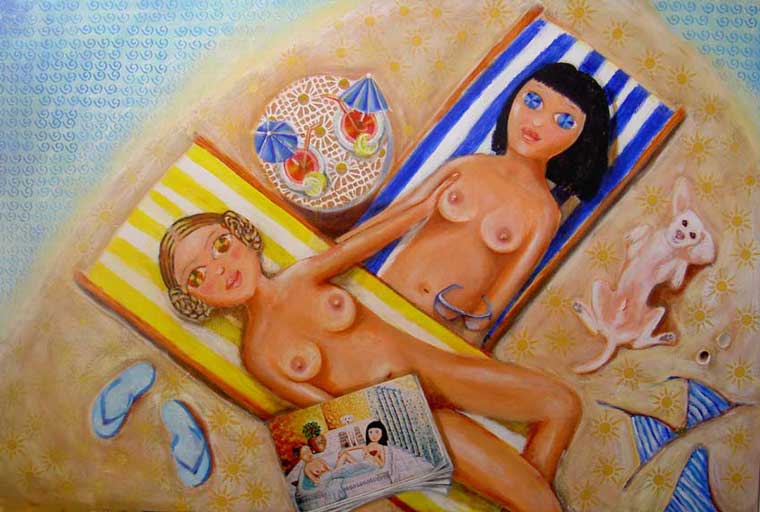
Naked woman sleeping...

Εδώ και καιρό έχω αφεθεί να με σκλαβώσει μια καθημερινότητα που με πνίγει. Με την ελπίδα ότι πολύ σύντομα θα έρθουν πιο όμορφες μέρες συνεχίζω το έργο μου πάνω στην γη...
Έρχονται όμως και κάτι στιγμές που με βρίσκουν μπροστά σε κάτι πολύ όμορφο που με ξαφνιάζει, με συγκινεί και τότε συνειδητοποιώ πως αυτή η μικρή στιγμή, αυτή η αναπάντεχη ομορφιά, μου δείχνει το δρόμο για να συνεχίσω να ελπίζω και να ονειρεύομαι...
Αναζητώντας τέτοιες στιγμές μαθαίνεις να ξεχωρίζεις την ομορφιά σε πολύ απλά πράγματα που ίσως κάποιοι την προσπεράσουν αδιάφορα κάποιοι άλλοι όμως την αποτυπώνουν σε έναν καμβά, σε ένα κομμάτι χαρτί...

(Στην ομορφιά σου...)


ΠΑΜΠΛΟ ΝΕΡΟΥΔΑ
ΕΡΩΤΙΚΟ ΣΟΝΕΤΟ XXVII

ΓΥΜΝΗ είσαι τόσο απλή σαν ένα από τα χέρια σου
λεία, γήινη, ελάχιστη, διάφανη, στρογγυλή,
έχεις γραμμές του φεγγαριού, μονοπάτια του μήλου,
γυμνή είσαι αδυνατούλα σαν το γυμνό το στάρι

Γυμνή είσαι γαλανή σαν τη νύχτα στην Κούβα
έχεις μες στα μαλλιά σου περικοκλάδες κι άστρα,
πελώρια είσαι, γυμνή, και κίτρινη είσαι
σαν καλοκαίρι σε χρυσή εκκλησία

Γυμνή είσαι τόση δα σαν ένα από τα νύχια σου,
καμπύλη, απαλή, ρόδινη, ώσπου γεννιέται η μέρα
και μπερδεύεσαι τότε μες τα υπόγεια του κόσμου

σαν μέσα σ' ένα τούνελ όλο δουλειές και ρούχα:
η λαμπράδα σου ντύνεται, σβήνει, φυλλομαδιέται,
κι ένα γυμνό σε λίγο ξαναγίνεται χέρι.

Τρίτη, Ιουλίου 25, 2006

Εξετάζοντας την βία στις σχέσεις των ομοφυλόφιλων γυναικών

Σε μεγάλο ποσοστό οι έρευνες που σχετίζονται με την ενδοοικογενειακή βία έχουν ως σημείο αναφοράς τους τα ετερόφυλα ζευγάρια και κυρίως την βία που ασκείται από τους άνδρες στις γυναίκες. Τα τελευταία δέκα περίπου χρόνια στο επίκεντρο των ερευνών έχει περιέλθει και η βία που ασκείται ανάμεσα στα ομοφυλόφιλα ζευγάρια.

Θα περίμενε κανείς ότι αυτό το φαινόμενο δεν υφίσταται σε μεγάλο βαθμό. Ένας από τους λόγους, όπως έχουμε μεταφράσει σε προηγούμενο post, θα μπορούσε να είναι ο εξής: κάποιος θα περιμένει ότι το τα ομόφυλα ζευγάρια διαχειρίζονται τις διαφωνίες τους καλύτερα γιατί αντιλαμβάνονται τον κόσμο από την ίδια οπτική. Είναι ένα φαινόμενο με πολλές προεκτάσεις και θα επανέλθουμε στο μέλλον με περισσότερες πληροφορίες για το θέμα αυτό.


Στο ακόλουθο άρθρο παρουσιάζονται δύο βιβλία για την βία στις λεσβιακές σχέσεις:

Russo, Ann. Recognizing Difference: Exploring Violence in Lesbian Relationships. Psychology of Women Quarterly. 27 (March 2003): 86.


Recognizing Difference: Exploring Violence in Lesbian Relationships

Intimate Betrayal: Domestic Violence in Lesbian Relationships, ELLYN KASCHAK (Ed.).
Haworth Press, 2001. 138 pp., $19.95, (paper), ISBN 0-7890-1662-1.

No More Secrets: Violence in Lesbian Relationships, JANICE L. RISTOCK. New York: Routledge, 2002. 224 pp., $21.95, (paper) ISBN 0-415-92946-6; $85.00 (cloth) ISBN 0-415-92945-8.


The existence of violence in lesbian relationships raises critical questions about feminist "commonsense" knowledge about the interpersonal violence in women's lives. Within the contemporary U.S., the focus of feminist research, analysis, and advocacy has been primarily on men's interpersonal violence against women. The perpetuation of endemic violence against women has been attributed to a sexist and male-dominant society. Violence within lesbian relationships disrupts this mainstream feminist analysis. Ellyn Kaschak's edited volume Intimate Betrayal and Janice Ristock's No More Secrets both are important contributions to the growing body of literature exploring the sources and dynamics of lesbian violence and implications for feminist theories and practices addressing violence against women in general. The authors, from a variety of perspectives, encourage us to rethink and reconceptualize feminist assumptions and approaches to the violence in women's lives given the lesbian-specific contexts.

Kaschak's anthology of essays, Intimate Betrayal, offers an array of perspectives on violence in lesbian relationships, particularly from the field of psychology. The authors in this volume ask key questions, such as: What is the prevalence of violence in lesbian relationships? What are the factors—psychological as well as social—that contribute to the perpetration of violence in lesbian relationships? How does internalized homophobia impact victims and perpetrators of lesbian violence? And how do homophobia and heterosexism inform the ways that social institutions respond to violence in lesbian relationships? How do research, services, and programs more adequately and effectively address this violence? The answers to the questions offered in the volume seem consistent in their arguments that violence in lesbian relationships is a significant issue worthy of serious attention and that homophobia and heterosexism must be directly addressed in any effort to understand and to intervene in its perpetuation. These arguments are important given that most research and organizations use a one-size-fits-all approach to domestic violence (i.e., heterosexual men's violence against women), sometimes with a simple addition of "homophobia" to the formula for batterers. The salience of this problem is underscored by Erin M. McLaughlin and Patricia D. Rozee's essay, "Knowledge about Heterosexual versus Lesbian Battering Among Lesbians," that reveals that lesbians are much more able to identify, label, and understand the dynamics of heterosexual domestic violence than they are lesbian violence. This lack of knowledge has serious consequences in potential intervention into and prevention of violence in lesbian relationships.

One of the key questions raised is how do we understand the causes of lesbian violence against their intimate partners? Most work in the field suggests that lesbian violence is different from heterosexual men's violence. It cannot be solely attributed to male domination (women are the perpetrators of violence), and it cannot be attributed solely to a social power dynamic (perpetrators are not always the ones with social power). These have often been the explanations offered in mainstream feminist discourses. Lesbian theorists and advocates along with women of color have consistently argued that the gender-exclusive framing of domestic violence is limited and problematic. Several essays in this volume offer research and analysis that furthers our understanding of the perpetrators of lesbian violence and the social and psychological forces that shape their violence. Two of the authors (Kimberly Balsam, "Nowhere to Hide" and Leanne Tigert, "The Power of Shame"), for instance, argue that homophobia and heterosexism are factors that contribute to the perpetration of violence in lesbian relationships. For instance, Tigert argues that we might look at the perpetration of violence as "oppression sickness." Within this framework, violence is a "reenactment of and response to cultural traumatization" (p. 75). She argues that the anger and shame resulting from homophobia and heterosexism impact the victims and perpetrators of violence in lesbian relationships. I agree with Tigert that therapists and counselors must address internalized homophobia and the impact of living in homophobic and heterosexist contexts on violence. If we are interested in the roots of violence, this is essential. What is troubling, however, is how, in the course of the essay, she begins to talk about victims and perpetrators without attention to their different and unequal roles in violent relationships. I am troubled by this conceptual move in her analysis, and yet at the same time, I agree that shame and anger arising from homophobic contexts do underlie and perpetuate violence. My concern is that the discussion of "oppression sickness" shifts the empathic focus to "perpetrators" in ways that might keep "victims" hooked into relationships that are destructive to them. This may lead to making "perpetrators" less accountable for their behavior and its effects. Tigert's essay contributes to a deeper understanding of the dynamics of shame and anger and how they are fueled by homophobia, and yet I do not want issues of accountability for violence and its effects on the victimized lesbians to be decentered in this analysis.

Disrupting our heterosexist assumptions regarding domestic violence is central to Janice Ristock's book, No More Secrets: Violence in Lesbian Relationships. Ristock uses a postmodern approach to violence in lesbian relationships; she hopes to disrupt the binaries created by universalist, White-dominant, and heterosexist approaches to domestic violence, such as victim/perpetrator and power/powerlessness. Through an analysis of interviews with lesbians who have experienced violence in their intimate relationships (mostly victims, a few perpetrators, a few who identify as both) as well as interviews with lesbian service providers, Ristock argues against the assumption that domestic violence is always about power and control of one partner over another. She further challenges the assumption that individuals have stable, monolithic, and unchanging identities as either victims or perpetrators. Instead, she argues that the power and control may be more fluid in lesbian relationships characterized by violence and that power dynamics may shift and change within a relationship. For example, through her interviews, she finds that some lesbians who initially experienced themselves as victims say that they shifted to abusive tactics at a later point in their relationships. While Ristock takes care to argue against the assumption that lesbian battering is really just "mutual abuse," some of her examples and her conclusions seem to support this claim. As I read some of the excerpts and her interpretations, I began to wonder how the women she interviewed came to identify themselves as either "victims" or "perpetrators," and whether we could assume their construction of themselves as "victims" and/or "perpetrators" was "accurate." Because the excerpts provided are from much longer narratives, they are decontextualized and broken up for the purposes of analysis. Moreover, given the postmodern approach that encourages fragmentation and contradiction, it seemed difficult to rely solely on the fragmented parts of the stories for answers to these complicated questions. I found that I had many questions. I wanted to hear the full stories; I felt that it was hard to judge what was happening in the relationships from the excerpts given. At the same time, I am aware that the complexities she is drawing attention to make me uneasy. And this dis-ease is precisely Ristock's point in asking us to rethink our assumptions and the way that the accepted discourse may limit our understanding of violence in lesbian relationships. The questions raised are significant ones that researchers, service providers, and community activists must consider in our efforts to address and to prevent violence in lesbian relationships.

Ristock argues against universalized assumptions and asks us to pay attention to specific contexts of violence and forms of violence, rather than to assume that it is all the same. Her argument is compelling and her examples build the case. To assume that all violent relationships are the same and that they must be approached in the same way has contributed to the invisibility, denial, and minimization of violence in lesbian relationships. Ristock offers several contexts in which violence in lesbian relationships takes place and suggests that the dynamics are different in these contexts and thus intervention and prevention strategies might be made more specific. The contexts that she identifies include "contexts of first relationships, contexts of the closet and homophobia, and contexts of dislocation such as recent immigration." In addition, she writes, "There are also contexts in which violence is normalized. These can include using drugs and alcohol, having a history of previous abuse, and experiencing a lifetime of abuse in a context of poverty and racism" (p. 57). She suggests that the contexts "may increase the probability of experiencing or committing violence," although she's not making a causal argument. She illustrates, through the stories, the impact of these contextual factors on the individual women's lives that she interviewed. What seems less clear is how the intervention and prevention strategies might differentially address these contexts.

Ristock's book is a worthwhile and important contribution to the literature on violence in lesbian relationships and is a must-read. The questions and complexities that she is raising are essential in developing an adequate framework for intervention into violence in lesbian relationships. While Ristock argues for the distinctiveness of violence in lesbian relationships, her attention to the specificity of relational and social contexts as well as complexities and fluidity of power in interpersonal dynamics shed light on the inadequacy of a "one-size-fits-all" approach to domestic violence.

Ann Russo, Associate Professor, Women's Studies Program, DePaul University, is author of Taking Back Our Lives: A Call to Action in the Feminist Movement (2001) and co-author of Pornography: The Production and Consumption of Inequality (1998).

Παρασκευή, Ιουλίου 21, 2006

Τι γνωρίζει ο κόσμος για τα oμοφυλόφιλα ζευγάρια; (μέρος 2ο)

(συνέχεια)

Αντιλαμβανόμενη κοινωνική υποστήριξη: Η υποστήριξη που απολαμβάνει ένας σύντροφος από το κοινωνικό του περίγυρο επηρεάζει της υγεία της σχέσης καθώς πρόσφατες έρευνες δείχνουν ότι οι σχέσεις αναπτύσσονται μέσα σε κοινωνικά πλαίσια.
Σε αναλογία με τα ετερόφυλα ζευγάρια, οι ομοφυλόφιλοι είναι λιγότερο πιθανόν να αναφέρουν μέλη της οικογένειάς τους ως υποστηρικτές και είναι πιο πιθανόν να αναφέρουν φίλους τους. Η έλλειψη οικογενειακής υποστήριξης αποτελεί μια μοναδική πηγή στρές και πιθανόν αντιπροσωπεύει την έλλειψη νομικής, κοινωνικής, πολιτικής, οικονομικής και θρησκευτικής που απολαμβάνουν τα ομόφυλα ζευγάρια για τις σχέσεις τους. Από την άλλη η υποστήριξη που απολαμβάνουν από τους φίλους τους αντισταθμίζει την έλλειψη institutionalized υποστήριξης.

Σταθερότητα: Είναι ίσως η πιο σημαντική ερώτηση: αν και πόσο διαρκούν οι ομόφυλες σχέσεις. Έρευνες που δείχνουν ότι μεταξύ 8 με 21% των γυναικών και μεταξύ 18 με 28% των ανδρών έχουν ζήσει μαζί 10 ή περισσότερα χρόνια , είναι ενδεικτικό ότι μπορούν και χτίζουν σχέσεις ανθεκτικές σε βάθος χρόνου. Οι έρευνες γύρω από το θέμα αυτό είναι λίγες και σποραδικές και δεν μπορούν να εξαχθούν ασφαλή συμπεράσματα. Το πιο εντυπωσιακό όμως είναι ότι σε σχέση με τα ετερόφυλα ζευγάρια τα ομόφυλα κατορθώνουν να αντέχουν χωρίς τα οφέλη της εκάστοτε κρατικής μηχανής.

Παράγοντες που προβλέπουν την ποιότητα της σχέσης: Ένας τρόπος για να ελεγχθεί κάτι τέτοιο είναι αν οι δεσμοί μεταξύ των μεταβλητών που σχετίζονται με την λειτουργία της σχέσης και την ποιότητά της είναι τόσο δυνατοί για τα ομόφυλα ζευγάρια όσο και για τα ετερόφυλα. Οι παράγοντες της ποιότητας μιας σχέσης που έχουν εξεταστεί συνήθως προέρχονται από τέσσερις ομάδες μεταβλητών που χρησιμοποιούνται στις έρευνες των σχέσεων γενικότερα. Είναι τα χαρακτηριστικά που φέρνει ο κάθε σύντροφος στη σχέση (όπως αυτά της προσωπικότητας), πως βλέπει ο κάθε σύντροφος την σχέση (όπως το επίπεδο εμπιστοσύνης), πως συμπεριφέρονται οι σύντροφοι μεταξύ τους (όπως επικοινωνία και τρόποι διευθέτησης διαφωνιών) και επίπεδο υποστήριξης για την σχέση (όπως συγγενείς και φίλοι).

Τα αποτελέσματα δείχνουν πως οι δεσμοί των μεταβλητών από τις προαναφερθείσες τέσσερις κατηγορίες και η ποιότητα της σχέσης των ομόφυλων δεν διαφέρει από τους παράλληλους δεσμούς των ετερόφυλων ζευγαριών. Έτσι, παρά τις εξωτερικές διαφορές που ευρίσκονται στα ομόφυλα ζευγάρια, οι σχέσεις τους φαίνεται να λειτουργούν με τον ίδιο τρόπο όπως και οι ετερόφυλες σχέσεις.

Με βάση τα αποδεδειγμένα οι ομόφυλες σχέσεις επηρεάζονται από τα ίδιες ομάδες παραγόντων που επηρεάζουν τις ετερόφυλες. Η κρατική υποστήριξη για τις ομόφυλες σχέσεις θα μπορούσε να εντείνει την σταθερότητά τους όπως συμβαίνει και στους ετερόφυλους γάμους. Αυτό το γεγονός, διαμόρφωσε μια από τις βάσεις πάνω στις οποίες η Αμερικανική Ένωση Ψυχολόγων αποφάσισε να περάσει μια απόφαση που θεωρούσε αδικία να μην αναγνωρίζεται στα ομόφυλα ζευγάρια το δικαίωμα γάμου με όλα τα συνεπαγόμενα οφέλη, δικαιώματα και προνόμια (Αμερικανική Ένωση Ψυχολόγων, 2004).

Σάββατο, Ιουλίου 15, 2006

Τι γνωρίζει ο κόσμος για τα ομοφυλόφιλα ζευγάρια; (μέρος 1ο)

Έχοντας ως δεδομένο την ολοένα αυξανόμενη παρουσία ομόφυλων ζευγαριών στην μεγάλη οθόνη αλλά και τις αναφορές στον Τύπο διαπιστώνουμε ότι από την μια αυτό αποτελεί ένα θετικό γεγονός από την άλλη όμως προκαλεί παρανοήσεις για τον τρόπο ζωής των ομόφυλων ζευγαριών και για τα δεδομένα που ισχύουν στις σχέσεις τους . Άραγε τι γνωρίζει ο κόσμος για τα ομόφυλα ζευγάρια;

Αφορμή για όλα αυτά αποτέλεσε η έρευνα που κάναμε και βρήκαμε ένα πολύ ενδιαφέρον άρθρο του Lawrence A. Kurdek με τον τίτλο What Do We Know About Gay and Lesbian Couples? που δημοσιεύτηκε στο περιοδικό Current Directions in Psychological Science τον Οκτώβριο του 2005. Επιλεκτικά μεταφράσαμε κάποια κομμάτια και σας τα παραθέτουμε.

Περίληψη: Είναι μια έρευνα που έγινε σε ομόφυλα ζευγάρια σε σχέση με θέματα που αφορούν τις δουλείες στο σπίτι, τις διαφωνίες, την ικανοποίηση, την αντιλαμβανόμενη κοινωνική υποστήριξη, την σταθερότητα καθώς και τους παράγοντες που προβλέπουν την ποιότητα της σχέσης. Στο σύνολο της η έρευνα υποδεικνύει ότι τα ομοφυλόφιλα ζευγάρια τείνουν να είναι πιο όμοια παρά διαφορετικά από τα ετερόφυλα.

Δουλειές στο σπίτι: η αντίληψη που επικρατεί για τα ευτυχισμένα ζευγάρια είναι ότι ο κάθε σύντροφος συνεισφέρει στη δημιουργία θετικού κλίματος στο ζευγάρι. Όταν ένα ζευγάρι συζεί, ο βαθμός στον οποίο εξαρτάται το ένα από το άλλο αυξάνεται και το ερώτημα ‘ποιος κάνει τι’ έρχεται στην επιφάνεια. Για πολλά ετερόφυλα ζευγάρια το ‘βιολογικό σεξ’ αποτελεί έναν πολύ σημαντικό παράγοντα για τους ρόλους που αναλαμβάνουν οι σύντροφοι. Έχοντας αυτήν την δήλωση υπόψιν ο διαχωρισμός της οικιακής δουλειάς σε ομόφυλα ζευγάρια προσφέρει ένα ερέθισμα έρευνας για το πως οι ρόλοι διαχωρίζονται ανεξάρτητα από το ‘βιολογικό σεξ’. Από αυτό συνάγονται τρία συμπεράσματα. 1ο: τα ομόφυλα ζευγάρια δεν αποδίδουν ρόλους όπου ο ένας θα είναι ο ‘άντρας’ και ο άλλος ‘γυναίκα’. 2ο: αν και ο διαχωρισμός δεν είναι τελείως ισότιμος είναι πιο πιθανόν να διαπραγματευτούν μια δίκαιη κατανομή που θα συνάδει με τα ενδιαφέροντα και τις δεξιότητες του κάθε ενός και 3ο: όσο εδραιώνεται η σχέση τόσο οι σύντροφοι είναι πιθανόν να ειδικευτούν στις δουλείες του σπιτιού.

Διαφωνίες: Στα ετερόφυλα ζευγάρια οι διαφωνίες προκύπτουν από την διαφορετική οπτική που βλέπει τα πράγματα ο άντρας και η γυναίκα. Αν αυτή η δήλωση έχει κάποια βάση τότε κάποιος θα περιμένει ότι το τα ομόφυλα ζευγάρια διαχειρίζονται τις διαφωνίες τους καλύτερα γιατί αντιλαμβάνονται τον κόσμο από την ίδια οπτική.

Σε μια έρευνα, όπου βιντεοσκοπήθηκαν ετερόφυλα και ομοφυλόφιλα ζευγάρια την στιγμή που συζητούσαν προβλήματα της σχέσης τους, προκύπτουν τα ακόλουθα συμπεράσματα: σε σχέση με τα ετερόφυλα ζευγάρια οι ομοφυλόφιλοι ξεκινούν τις συζητήσεις τους με πιο θετικό πνεύμα και διατηρούν αυτήν την στάση καθόλη τη διάρκεια της συζήτησης. Άλλα στοιχεία δεικνύουν ότι τα ομοφυλόφιλα ζευγάρια λύνουν τις διαφορές του πιο εποικοδομητικά και είναι λιγότερο πιθανό ο ένας σύντροφος να απαιτεί και άλλος να υποχωρεί. Ο λόγος είναι ότι τα ομόφυλα ζευγάρια εκτιμούν την ισότητα και έχουν λιγότερες διαφορές status μεταξύ τους.

Κάτι που προέκυψε από την έρευνα είναι ότι οι λόγοι διαφωνίας σε ετερόφυλα και ομοφυλόφιλα ζευγάρια είναι οι ίδιοι: οικονομικά, στοργή, σεξ, έντονη κριτική, τρόπος οδήγησης και δουλείες του σπιτιού.

(συνεχίζεται)

Πέμπτη, Ιουλίου 13, 2006

Μια ευχάριστη gay screwball κωμωδία


Χθες το βράδυ είδαμε την ταινία Ένα Άγγιγμα λίγο... Ροζ (Touch of Pink) του Ian Iqbal Rashid.
Είναι η ιστορία του Alim, ενός Ισμαϊλο-καναδού Μουσουλμάνου ο οποίος ζει στο Λονδίνο με τον σύντροφο οικονομολόγο του. Ζει μια ζωή που κρατά κρυφή από την μητέρα του και την υπόλοιπη οικογένεια που μένει στο Τορόντο. Η προσπάθειά του να τα βρει με τον εαυτό του διακόπτεται όταν η μητέρα του, εν όψει του γάμου του ανιψιού της, αποφασίζει να βρει το γιο της στο Λονδίνο να τον πείσει να παρευρέθη στον γάμο και να γνωρίσει κάποια μουσουλμάνα κοπέλα να παντρευτεί...Ακολουθούν οι συνηθισμένες προσπάθειες για παραπλάνηση της μητέρας σε ότι αφορά την σεξουαλικότητα του Alim και του άνδρα που αγαπά.
Κάτι που κάνει την ταινία ιδιαίτερη είναι η σχέση του Alim με τον φανταστικό παιδικό φίλο του ο οποίος είναι η ενσάρκωση του Cary Grant...Η ταινία διανθίζεται από διάλογους με αυτόν τον φανταστικό φίλο που αντιπροσωπεύει τρόπον τινά τον εξομολογό του αλλά αντικαθιστά και το απόν πατρικό πρότυπο στην ζωή του νέου...
Έχουμε γράψει αρκετά για την υπόθεση...
Η ταινία αγγίζει θέματα για βαθύτερη εξερεύνηση όπως αυτά της σεξουαλικότητας στην Μουσουλμανική κουλτούρα, τις διαπολιτσμικές ομοφυλοφιλικές σχέσεις καθώς και για τις συνηθισμένες επικρατούσες αντιλήψεις που αφορούν τις ομόφυλες σχέσεις.


Η ταινία προβλήθηκε με επιτυχία το 2004 στο φεστιβάλ κινηματογράφου του Sundance

Για περισσότερες πληροφορίες σας παραπέμπουμε στην ιστοσελίδα της ταινίας:
http://www.sonyclassics.com/touchofpink/

Η συνέχεια επί της οθόνης σας.

Τετάρτη, Ιουλίου 12, 2006

Προτεινόμενες ιστόσελιδες

Ακολουθεί μια λίστα με προτεινόμενες ιστοσελίδες ακαδημαϊκού περιεχομένου στην πλειοψηφία τους, για θέματα που σχετίζονται με την ομοφυλοφιλία, την σεξουαλικότητα και την ιστορία. Για κάθε ιστοσελίδα υπάρχει και μια περίληψη του περιεχομένου της.
Η επιλογή των ιστοσελίδων έγινε απο
http://www.humbul.ac.uk/ μια βάση δεδομένων καταγραφής και περιγραφής ιστοσελίδων που υποστηρίζεται απο το Πανεπιστήμιο της Οξφόρδης.

Καλή πλοήγηση λοιπόν...

Bibliography of Gay and Lesbian History/ by Rictor Norton
URL: http://www.infopt.demon.co.uk/bibhist.htm

Rictor Norton, a historian of queer history, has compiled this online bibliography on gay and lesbian history. The bibliography is regularly updated, and provides extensive coverage of the secondary resources available on gay and lesbian history. It is broken down into twenty-nine separate categories, which cover a range of countries, time periods, and areas. Geographically the bibliography covers England, Germany, Holland, France, Spain & Portugal, the United States, Latin America, the Middle East, and China, India and Japan.

Latin American and Iberian Collections at Stanford: Bibliography of Sexuality Studies in Latin America

URL: http://www-sul.stanford.edu/depts/hasrg/latinam/balder.html

This Web site offers an impressively long bibliography of sexuality studies in Latin America. Based upon a bibliography that first appeared in Daniel Balderston and Donna J Guy's edited volume, Sexuality in Latin America (New York University Press, 1997), and incorporating subsequent updates, this online bibliography is current, well-maintained and regularly updated. It includes both print and online secondary studies (with links included where relevant) in Spanish, English or Portuguese by international scholars, critics and commentators. The scope is vast, covering gender studies, gay and lesbian studies, and women's studies across the disciplines of the arts (including literature; film; and the performing and plastic arts) cultural and area studies; history; sociology; and psychology

Diversity Syllabi Project
URL:

http://www.apa.udel.edu/apa/governance/committees/

diversitysyllabiproject/index.html

In a project initiated by Cheshire Calhoun, the American Philosophical Association (APA) has been collecting syllabi from Philosophy courses that focus on the theme of diversity. At the Diversity Syllabi Project site administered by the APA, site users can find links to reading lists related to such themes as African American Philosophy; American Indian Philosophy; Asian Philosophy; Feminist Philosophy; Philosophical Perspectives on Disability Issues; Philosophy and Multiculturalism; and Gay and Lesbian Philosophy. The APA hopes that this site will encourage other instructors to develop courses of their own in these various fields, or to incorporate elements from topics which range from diversity, to art and aesthetics, to race and multiculturalism into more general Philosophy courses. There are a few broken links..


Gay History and Literature by Rictor Norton

URL: http://www.infopt.demon.co.uk/gayhist.htm

Gay History and Literature is the work of Rictor Norton, a historian of queer history. It is an excellent site crammed with information and resources relating to gay and lesbian history. On the home page users will find over 50 short essays on different aspects of queer history, under topics headings like the history of homoerotica, lesbian history, the history of homophobia, queer culture, and the homosexual pastoral tradition. In addition to these articles, the site also contains a section on John Addington Symonds, primary sources on homosexuality in eighteenth-century England, book reviews, bibliographies, articles on social constructionism and queer theory, and a range of web links..


Gay, Lesbian and Transgender Historical Society
URL: http://glbthistory.org/

The Gay, Lesbian and Transgender Historical Society collects, archives and exhibits material that deals with the history of homosexuals and other sexual minorities. The main focus of the society is GLBT history in the United States of America, although it does also hold a few world sources as well. This well-designed site contains a lot of information about the society, with details of membership and forthcoming events and exhibitions. In addition to this there are two searchable online catalogues, which allow users to search the archive and manuscript content and the periodical holdings of the society, kept in their library and archive in Northern California.


Hall – Carpenter Archives
URL: http://www.lse.ac.uk/library/archive/gutoho/hall_carpenter_archives.htm

This is the web site for the Hall-Carpenter Archives, which is part of the London School of Economics Library web site that provides a guide to its archive holdings. Founded in 1982, the Hall-Carpenter Archives are the largest source for the study of gay activism in the late twentieth century, from the publication of the Wolfenden Report in 1958 onwards. The archives are comprised of four main collections, the periodicals collection, the archive of gay organisations and activists, the Lesbian and Gay Newsmedia Archive, and the oral history collection. The archives are split across three sites, the London School of Economics Library, Middlesex University Library, and the National Sound Archive..

Human Sexuality Collection
URL: http://rmc.library.cornell.edu/HSC/default.htm

This is the web site for the Human Sexuality Collection (HSC) housed at Cornell University Library. The HSC has been established to preserve primary documents on the history of sexuality, with particular emphasis on the gay and lesbian history in the U.S. from the nineteenth century onwards, and the politics of pornography. Although users cannot access the full text of any of the collection's holdings online, the site offers several useful resources.


Stonewall and beyond: lesbian and gay culture

URL: http://www.columbia.edu/cu/lweb/eresources/exhibitions/sw25

Stonewall and Beyond is an online exhibition published by the Columbia University Libraries. It was put together for the 25th anniversary of the Stonewall riots that took place in New York in 1969, and provides an introduction to key elements of gay history. The exhibition uses digitised primary source material and well-written narrative to explore gay and lesbian history before and after the Stonewall riots. Topics covered include the riots themselves, early writings on homosexuality by people such as Margaret Mead, Edward Carpenter, and Sigmund Freud, homosexuality across the centuries, and queer diversity.

Gay History

URL: http://www.gayhistory.com/index.htm

This well-designed site on gay history is an excellent starting point for scholars of this subject. Written by an enthusiast, it covers the history of homosexuality from 1700 to 1973, focusing mainly on the United Kingdom and the United States. The main resource in the site is the timeline, which currently covers the eighteenth and nineteenth centuries, although there is some information about twentieth century events and individuals. Each date links to an article, which appears in a summarised and a longer format.

Marginality and community in medieval Europe
URL: http://www2.kenyon.edu/projects/margin/margin.htm

Designed by history students of Kenyon College (Gambier, Ohio), 'Marginality and Community in Medieval Europe' offers a good introduction to a selection of medieval communities who found themselves socially isolated because of physical infirmities or what was regarded as deviant behaviour by medieval society. After a brief introduction to the topic, the site is divided into six major categories, covering medieval heresy, Jews, homosexuality, prostitution, leprosy, and witchcraft. Each sub-section offers some limited historical background about the relevant group’s status and, in the case of heretics, briefly explains the philosophies of such groups as Lollards, Waldensians, Beguines and Cathars. Perhaps the greatest strength of this site is the additional resources offered to users.

Russian gay culture

URL: http://community.middlebury.edu/~moss/RGC.html

This is a unique web site providing information on the history of gay culture in Russia/Soviet Union. Created by Professor Kevin Moss from Middlebury College, Vermont, it starts with the description of the book entitled "Out of the Blue", edited by the author of the site, which offers a pioneering collection (in English) of literature on gay themes written by 30 authors, from the early 19th century to the post-Soviet times. From Pushkin and Tolstoy to Makanin and Aksyonov, it gives a broad picture of homosexuality in Russia. The site includes an English translation of the poem "Antinous" by Mikhail Kuzmin - the first major figure in Russian gay literature, and gives information on Yevgeny Kharitonov - a major gay underground writer of the Soviet times.


Ιστορία των Ομοφυλοφίλων, Bisexual και Transgendered

Στην ακόλουθη ιστοσελίδα θα βρείτε την Ιστορία των Ομοφυλοφίλων, Bisexual και Transgendered από το Πανεπιστήμιο του Fordham. Η μελέτη θεωρείται η πιο πλήρης με αξιόλογες βιβλιογραφικές και ηλεκτρονικές παραπομπές:
http://www.fordham.edu/halsall/pwh/

Τετάρτη, Ιουλίου 05, 2006

The Wall by Marcelina Martin

The Wall by Marcelina Martin

Κάποια στιγμή θα καταρριφθούν οι τοίχοι που έχουν χτιστεί μέσα στον άνθρωπο...